In this episode of the Leveled Up Contractor Show I share with you how to get more out of your people with good job descriptions. If you want to run a successful construction business with multiple employees helping you hit your goals good job descriptions become a must!
Hiring good people is only the first step of growing your construction business. Once you have those people you have to properly onboard them, train them, and lead them. A clear job description will help both your as a leader and the employee perform the best. This is how you run a successful construction business.
Inside you will learn:
- Why job descriptions and clarity are so important.
- How to structure your job descriptions.
- How to create impactful measurables for your employees.
- The steps to creating job descriptions for every role in your company
- How to hold people accountable with great job descriptions
Contractor Tips: How To Get More Out Of Your People With Job Descriptions
Want our help implementing this into your business? Book a call here and let’s setup a strategy for your business.
Welcome to the Leveled Up Contractor Show for contractor systems, tools, training and more. In this episode, we’re going to be covering how to get more out of your people by having good job descriptions.
And guys, when I used to think about job descriptions, I thought it was some kind of formality or some piece of paper, that was just something we had to put on paper that talked about a few things, a specific position did. And I thought that’s really what it boiled down to.
Job descriptions are so much more than that. And even some people to this day, when you talk to them about job descriptions and they’re like, oh, those things you post online when you’re trying to hire somebody. Don’t get me wrong some of it is a formality that you have what their job is on a piece of paper. But It’s much more than that guys. I used to be like a lot of people, I thought this was just some formality and you know, something that we just had to have the paper to put in their HR file.
But all of a sudden, I started looking at job descriptions of people that we had, and other people were telling me, coaches, mentors, you got to have job descriptions to make sure everybody’s lined out on what they’re supposed to be doing. So I started looking at it and I’m like man, if that guy would’ve just done, what’s on this piece of paper…He would be doing really well, or he would have us in a position where we need to be, or I look at another one and be like, oh my gosh, if they were just doing that they would be doing awesome in that role.
So that’s when I made the switch, that’s when I was like. Ah, you know, job descriptions are more than just a piece of paper or something that, you put in somebody’s HR file.
They’re actually what your people should be doing. And that’s why they’re so important. That’s why I wanted to talk to you about it in this episode.
Why Job Descriptions Are So Important
So why are job description so important to creating clarity? Well, first of all, guys, it is what they’re supposed to do, right? If you hire somebody and you want to bring them on to fulfill a role within your company, the job description identifies the things that they’re responsible for and their measureables that they have to deliver on.
And then all the things that they have to do to make sure those measureables actually happen to succeed in the position. And when you have that, it creates clarity two ways. It creates clarity for that employee that, Hey, this is what I’m supposed to do. And two, it creates clarity for you or the manager of that person what that person is expected to do and what you should be holding them accountable to.
And now there’s a big key to this… A lot of people that you hire think that job descriptions are just a formality too. So that’s why when you hire them and you bring them on and you actually onboard them, you need to let them know that. This is your job description. This is what I expect from you. This is important.
You make it a big deal and you talk to them about it. You walk through with them, you ask them if they have questions and obviously day one, they’re not going to know a lot of this stuff. So you ask them if they got any questions, they’re going to ask a few questions here and there. A lot of them will say they got it right.
And then two weeks later, you follow up on it. Hey, let’s go over your job description again, just make sure. And now that you’ve been here a couple of weeks, let’s go over things, make sure everything makes sense. If you have any questions, all that kind of stuff. So you go through that.
How To Structure a Job Description
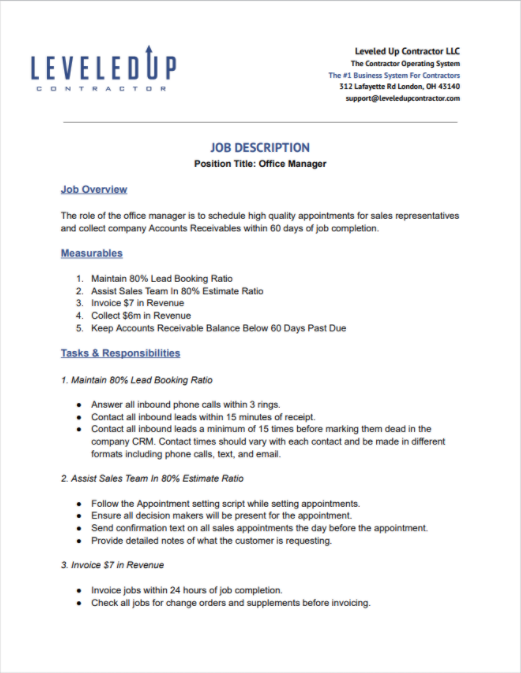
So, how do you actually structure a good job?
We keep Job Descriptions pretty simple. We keep it as simple as you can get it. I shouldn’t say that because some people like I said, they make it a formality and they have one chunk of text on a paragraph on one piece of paper and that’s their job description. That’s not what we do. But we keep it simple from a clarity standpoint when I say simple, that’s what I mean.
So at the top, You have their title, the name of that position, whether it’s project manager or sales rep or carpenter or lead carpenter or accountant or bookkeeper, whatever their role is in your company. That’s what you have at the top. Another thing you can have on there is who they report to.
If it’s a sales guy, does he report to the sales manager? If it’s a project manager, cause he reports the production manager, the field manager, or the bookkeeper, do they report to a CFO or an accountant or they report directly to the owner, whatever your structure is, what you can also have, who they report to.
So they know who their direct supervisor is. Next, we have measureables guys, measurables are one of the most powerful things that you could have in your company. And essentially what a measurable is, it is the things that they have to do that you could measure that are going to get a result for you and your company.
Right? So at the beginning of every year, You set big goals, you set a strategy to make it happen, and you’re going to have the right org structure and people to make that goal happen. And that’s where measurables come in. If I’m going to do $5 million in sales, I got to have salespeople that are going to help make that happen.
So on their specific job descriptions, I’m going to have measureables that they have to hit to make sure the company hits their goals. So that’s why measurables are important. And that’s why they’re the next thing on there. And guys less is more right. If you put 15 measurables on there for every one of your employees, they’re going to be focusing on all these different things and not going to do any good at all of them.
They’re not going to Excel in any of those, they’re going to be so spread out and focused on all these different things. Things are just going to fall through the cracks. You’re best to have one to five measureables that they solely focus on to make sure that they crush it on those one to five measureables and set your company up for success.
And then below that guys, we bullet pointed out all the different tasks and responsibilities that they have in their role. And the key to this guys is they may have three measureables, and they have a bunch of different tasks and responsibilities that they have to do on their job on a daily basis to hit those measurables.
So you define the measureables and you say, Hey, this is what this role is responsible for. And here’s all the tasks and responsibilities that have to happen in their day to day job to make sure that they hit their measureables because ultimately guys, it comes down to them hitting the measurables to get the results that you’re after.
How To Create Job Descriptions For Your Employees
How do you go about creating all these job descriptions for your employees? But one of the best ways to start is do you have an organizational structure and you have an org charter and accountability chart that shows where every person in your company is what department they’re in and what department do they bring value to the company in?
And if you have that in place, that’s where you start. If you don’t have that in place, I recommend that’s where you start. And because you set your company goals and then you got to build the org structure. That’s going to make sure that those goals happen so you build that org structure and then guys, then you start breaking it out into measureables.
Right? If I got to do 5 million in sales, how many sales guys do I need to have with my sales team? Do I need to have a sales manager in place? And then what are the measureables for those roles? To make sure we hit 5 million in sales and the same for your production side. Right. If we got to produce 5 million in work, you know, how many crews though, do I got to have?
How many people do I got to hire? How many project managers do I need and what are their specific measureables to make sure that we hit those goals? And then an accounting, what are we going to do to collect our money, to get our customer’s invoice, to make sure our financials are right.
And what are the measureables of those specific roles that are going to help us hit our goals? So that’s the first thing that you have to do.
And one of the ways we do this guys, we have templates for our clients in the Leveled Up Contractor Program, all these different systems and tools and templates that they have. We have the org structure templates, we have example or charts for all the different size companies and then we have, what’s called a measurable doc that has every single employee listed on it, that you then fill in all the measurable.
So you start at the top of the company on the top of your measureables doc, you have the owner of the company, then you have the next person down from them, and then you have your manager level, and then you have all your individual employees. When you get done with it, you got all your employees listed on it and maybe a five page document, but.
Their name, their title and all their different measurables. So you start there once you have that in place, guys, then now you’re ready to build awesome job descriptions because you’ve set your goals. You set, the org structure is going to take the happen. You set the measureables for all the people
to help you hit your goal. And now you can build a detailed job descriptions because you have measurables is now all you gotta do is define the tasks and responsibilities that they’re responsible for to make it happen.
How To Hold Your Team Accountable With Job Descriptions
So then how do you actually hold your team accountable once you have the job descriptions? So we talked about in the beginning, first of all, you got to let them know what’s important, and then you gotta follow up with it two weeks after and an employee. Now, if they’re already an employee and you’re doing this a new.
Bring them in have a, an alignment meeting with them, go over their job description, make the changes. If they’re not doing what’s in their job description and make sure that they know it’s important and something that you’re doing to help them succeed and to help the company succeed. And you’re doing that by providing clarity with the job description and then two weeks you do a, follow-up just like you want with a new hire. So you go over that with them and make sure they’re clearly, and they don’t have any questions. And then guys, then you start building it into your company culture.
So you should be having meetings with your employees regularly, you know, one-on-one style meetings where you’re going over their measureables, you’re going over their tasks and responsibilities. And whether they’re on target or off target now, obviously depending on your size, you as the owner or manager, don’t have to go to every individual employee in the company.
If you’re at an owner level, you’re going to your high level managers and making sure. They’re doing what they’re supposed to be in that they’re hitting their measureables. And if they’re hitting their measureables, there’s a good chance that the majority of the employees underneath them are hitting their measureables.
And if they’re not hitting their measureables, you start with them. You ask why, and then if you have to, you can dig deeper into the individual employees.
But the key is that you have some type of one-on-one meetings with your employees or your managers are having those one-on-one meetings. And they’re talking about measurables are talking about whether they’re on track or off track, and if they’re not hitting their measureables or talking about the tasks and responsibilities, to make sure they get their team on track for hitting their measurable.
And then guys, you’re talking about your measureables in your company meetings, right? When you’re in a sales meeting, you’re talking about the different measureables of the sales department as a whole, but you could also break down and talk about some individual metrics, you know, Hey, this is our top sales guy.
This is what our sales team close rates at. This is what our average job size, and you can start talking about all these different metrics and you can start bringing metrics into your different meetings that you have, you know, when you have your company meetings and you’re sharing the goals and the results of the company, you can talk about the big picture goals and how their individual departments and individual employees help make those goals.
You incorporate them into your employee reviews, right? So you, you could be doing year end reviews, which with each of your employees, you could be doing quarterly reviews, all that kind of stuff. When you make sure that their measureables and their tasks and responsibilities are talked about or. That review, right.
You know, are they hitting their numbers? Are they doing the different tasks and responsibilities? That’s making sure that they’re going to hit their numbers. If they’re off track, why are they off track? Is it because they’re not doing X, Y, and Z in their tasks and responsibilities. So now you can really start to dig into it.
And now you can reverse the system when you’re off track. Like, well, do we hit this measurable? No, we didn’t. And well, why didn’t we hit this special? Oh, it’s because so-and-so, isn’t doing this and now you have a way to fine tune things and figure things out when things aren’t working in that way, you can make sure you stay on track for your goals.
How To Organize Your Job Descriptions
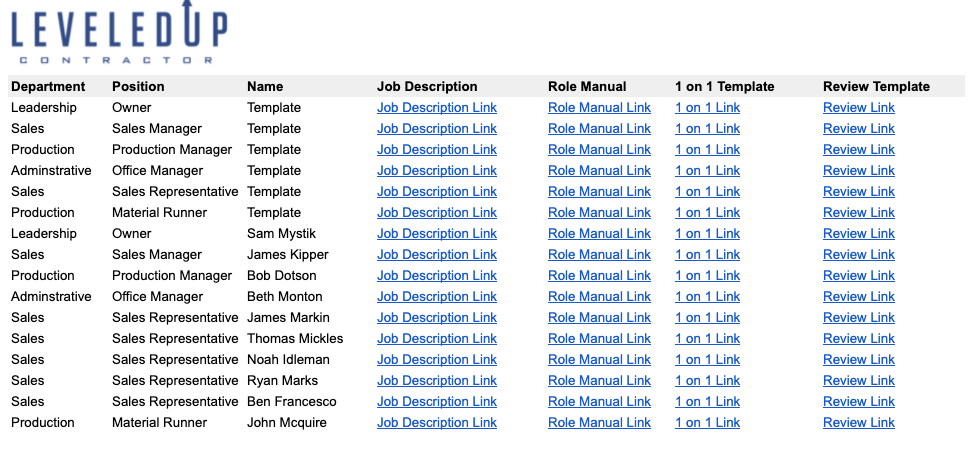
And then last but not least, guys, you got to get this thing organized. You know, who has you start building out job descriptions. You have a lot of files. You might have, you know, 20, 30, 50 employees, maybe you’re a five or 10, whatever the case may be, but you gotta get organized guys. And one of the ways that we teach our clients to do that is building what we call it a playbook.
Now there’s a lot more to a playbook than just job descriptions, but two of the tabs on that playbook sheet should be. The first half would be templates for all the different types of jobs you have in your company. So you might have five positions. You might have 15, you want to have 20, might have 30, all the different positions that you have in your company, you know, your lead set or your office manager, your bookkeeper, your carpenters, your.
Production manager, sales manager, whatever your roles are, you have a list of all those different titles. So all the different titles you have in your company, and you build a job description for each one of those roles as a template, and you have links to the individual documents that you created for the job descriptions, and you have templates.
Now, when I hire a new sales rep or a new project manager or a new bookkeeper, I have a template to work from. And then what you can do is you have a second tab on that playbook that has all your existing employees in the company, and a link to the job description that they’ve seen, that you reviewed with them.
And that they’ve signed saying that they understand that that is their role. So guys, I hope this was a big help. We’ll see you in the next one.
Want our help implementing this into your business? Book a call here and let’s setup a strategy for your business.
Other Awesome trainings:
Leave a Reply